Unify Cyber Protection with Acronis Cyber Protect Cloud

Overview
Acronis Cyber Protect Cloud brings backup, disaster recovery, endpoint management, and AI-powered cybersecurity together in a single platform. Built for Managed Service Providers (MSPs) and enterprise IT teams, it helps protect workloads, reduce operational complexity, and improve cyber resilience. Integrating with Acronis enables organizations to streamline security operations, automate workflows, and extend protection across their existing IT ecosystem.
Key Products
Acronis Cyber Protect Cloud
Unified cyber protection platform combining backup, AI-powered anti-malware, disaster recovery, endpoint management, and patch management in a single solution.
Acronis Endpoint & Extended Detection & Response (EDR / XDR)
Detects, investigates, and responds to advanced threats by correlating endpoint, identity, email, and network telemetry into a unified incident view.
Acronis Backup & Disaster Recovery
Protects workloads with secure backups, rapid recovery, ransomware protection, and disaster recovery across physical, virtual, and cloud environments.
Acronis Integration Architecture
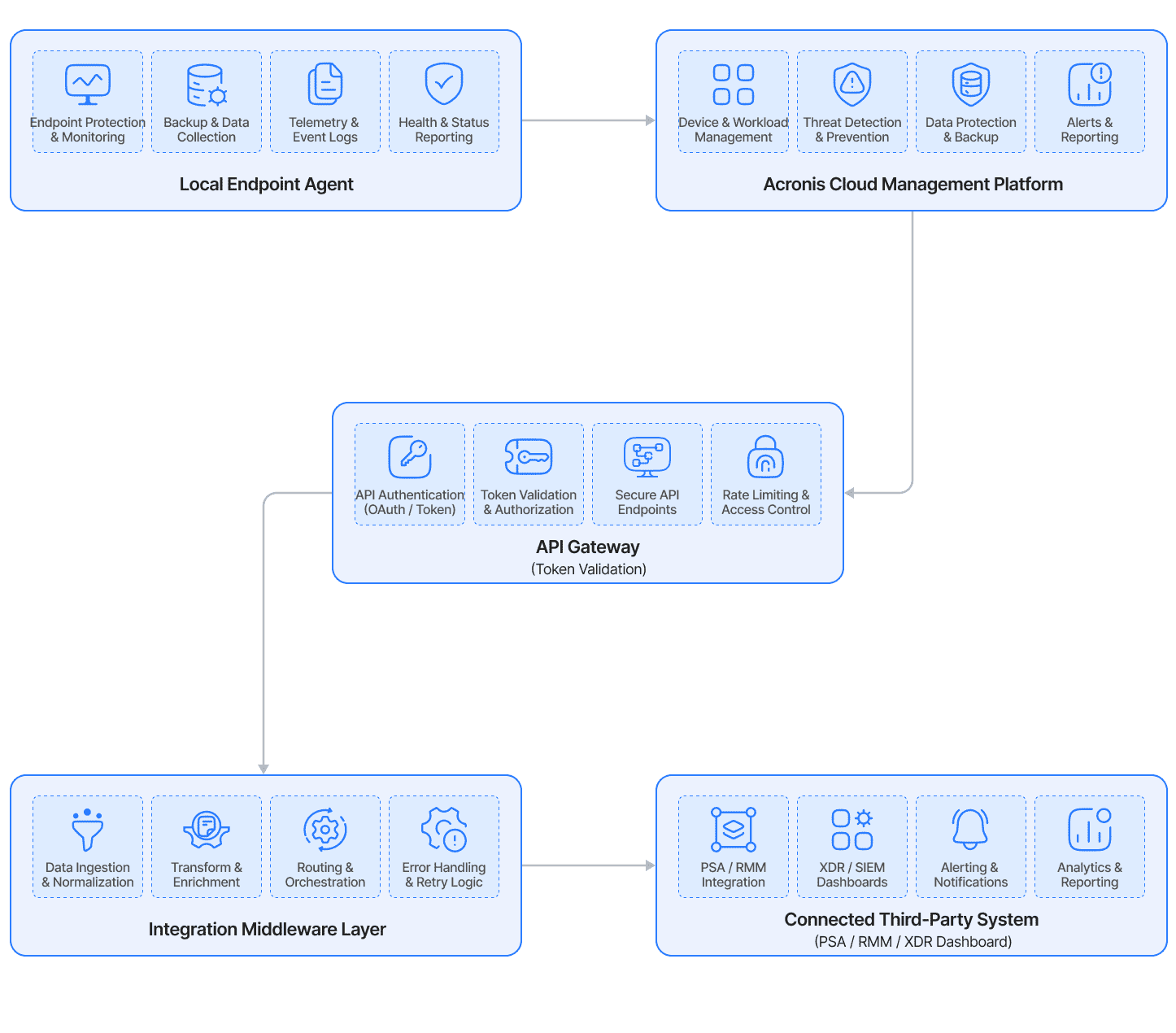
The integration links the external management platform to the Acronis System Core via secure REST endpoints or native CyberApp frames. Multi-tenant account hierarchies map symmetrically between both environments. Endpoint events and threat alerts detected by the local Acronis Protection Agent are sent to the Acronis Management Platform, triggering synchronised workflows, billing itemisations, or ticketing sequences within the connected ecosystem.
Streamlined Logic
1. Authentication: The external system initiates a session using an MSP-level Client ID and Secret to securely request an API access token from the Acronis Account Management gateway.
2. Customer Mapping: The integration queries the account infrastructure to bind external tenant definitions safely to corresponding Acronis customer identifiers.
3. Event Ingestion: The Acronis endpoint agent detects vulnerabilities, missing patches, or security threats and reports them to the Acronis Alert Manager. The integration layer polls the REST API for new alerts and forwards them to the connected PSA/RMM platform.
4. Data Sync & Action: The integration layer extracts the event payload, translates the JSON structure, and updates the external PSA/RMM console to run automation playbooks or log billable metrics.
Acronis Integration Benefits
Inbound CyberApps (Cyber Protect Console Extensibility)
Embeds third-party tools natively inside the Acronis Cyber Protect management console, giving service providers access to multi-tenant monitoring, widgets, and configuration interfaces in one tab.
Ticket Bridge API Alerting
Connects Acronis system alerts and protection failures directly to external PSA (Professional Services Automation) or RMM (Remote Monitoring and Management) infrastructure to auto-generate tracking tickets.
Account Management REST API
Syncs tenant hierarchies, provisions new end-user accounts, applies protection licensing templates, and updates customer usage metrics programmatically.
Endpoint Control Scripting Integration
Deploys custom management scripts and remote enforcement policies through the Acronis Cyber Protect agent, augmenting out-of-the-box monitoring frameworks on targeted endpoints.
Integration Use Cases
Automated Operational Syncing
We accelerate service delivery by linking tenant provisioning directly to your sales or billing pipelines. When you add or upgrade a customer account, the integration automatically provisions matching workloads and sets up licenses inside Acronis.
Centralized Security Contextualization
We optimize threat triage by routing live alerts into a single operational centre. Analysts can track backup health, malware detections, and vulnerability metrics alongside machine telemetry without switching tabs.
Fail-Safe Remediation Orchestration
We reinforce system stability with automated, cross-platform playbooks. For example, an external monitoring alert can trigger an instant Acronis snapshot backup right before a patch deployment, ensuring a zero-downtime rollback if needed.
Similar Connectors