Unify Threat Detection and Response with Exabeam

Key Products

Exabeam New-Scale Fusion
Combines cloud-native SIEM, behavioral analytics (UEBA), and automated response into a single unified security operations environment. It correlates disparate event logs to reveal full attack paths and dynamic risk scores.

Exabeam Security Analytics & UEBA
Uses machine learning models and histograms to establish baselines for normal behaviour across users, devices, and AI agents. It flags subtle deviations that bypass traditional correlation rules.

Exabeam Threat Center
Serves as the central analyst workbench for incident triage, case management, and investigation. It consolidates alerts into Smart Timelines to visualize the entire chronological flow of an incident.

Exabeam Nova AI Agents
An ensemble of multi-agent AI assistants embedded across the platform. Nova translates natural-language queries into search syntax, summarises attack narratives, and recommends next steps for investigation.

Exabeam Security Log Management
Delivers high-throughput ingestion, parsing, and multi-year storage across hot, warm, and cold tiers. It provides hyper-quick query performance over petabytes of data using a Common Information Model (CIM).
Automation Management & Incident Responder
Coordinates response workflows through prebuilt playbooks and a drag-and-drop orchestration engine. It triggers immediate actions in third-party security tools, such as isolating endpoints or revoking access credentials.
Exabeam Integration Architecture
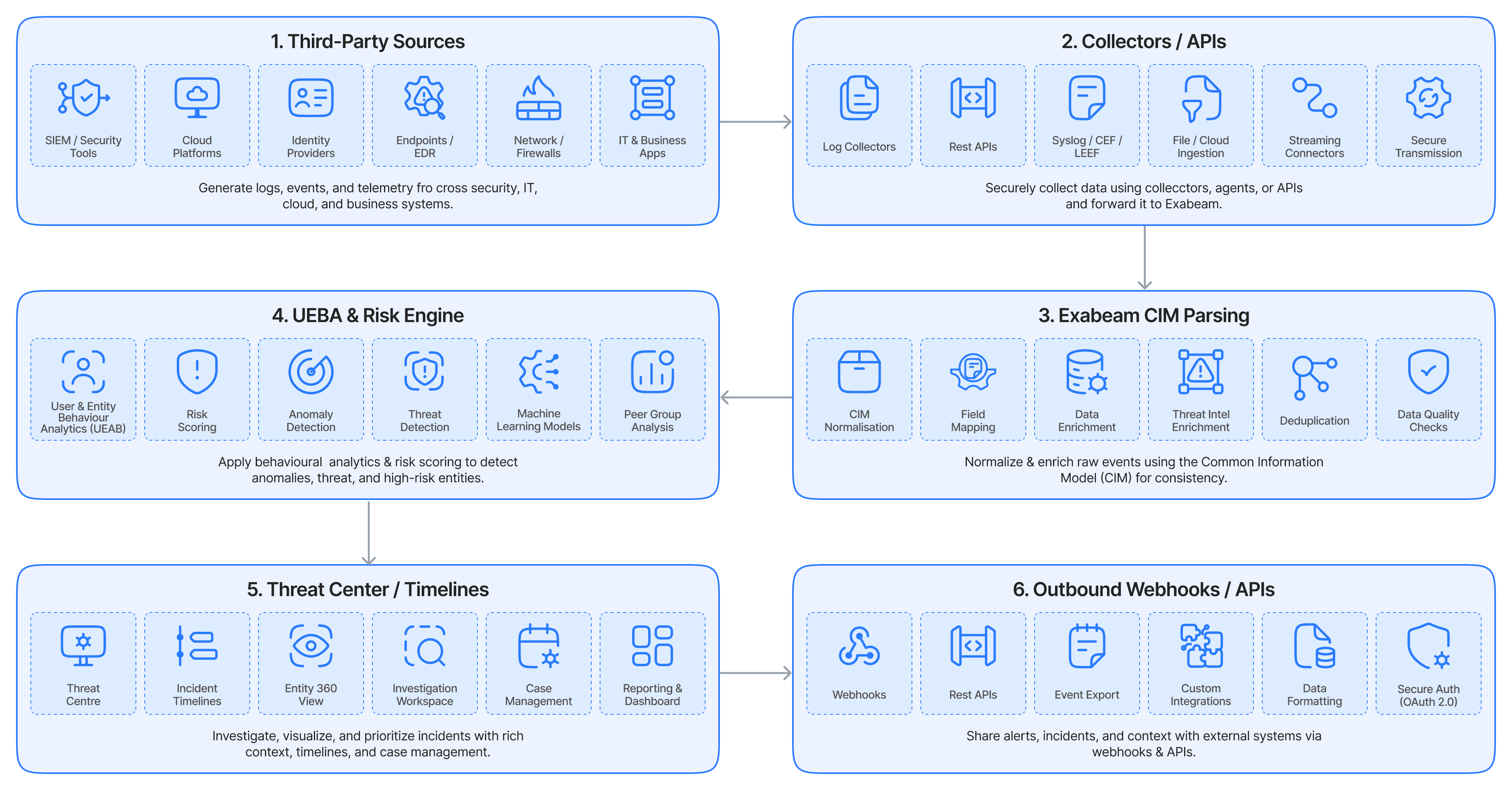
Data flows into Exabeam through API collectors or site forwarders, where events are parsed and normalized using the Common Information Model (CIM). Exabeam's UEBA engine analyzes behavior, assigns risk scores, and correlates threats in Smart Timelines. High-risk events trigger automated response actions through webhooks and REST APIs.
Architecture
1. Ingest & Transport: External logs and telemetry stream into Exabeam via Syslog, Cloud APIs, or Site Collectors over encrypted channels.
2. Parsing & Normalization: Exabeam transforms raw, unstructured log lines into standardized key-value fields aligned with the Common Information Model (CIM).
3. Context Enrichment: The Context Manager enriches incoming events with identity data from Directory Services (Active Directory, Okta) and Asset Management databases.
4. Behavioral Baseline & Risk Scoring: Machine learning models compare user and entity activity against historical baselines, incrementing risk scores when anomalies occur.
5. Timeline Aggregation & Triage: Threat Centre groups related anomalous events into chronological Smart Timelines for analyst evaluation.
6. Orchestrated Action: Automation Management executes playbooks, sending API payloads to EDRs, IAM systems, or firewalls to mitigate threats automatically.
Exabeam Integration Benefits
Cloud-to-Cloud API Collectors
Direct, serverless connectors that pull log streams, audit trails, and security alerts directly from cloud service APIs (e.g., AWS CloudTrail, Microsoft 365, CrowdStrike, Okta) into Exabeam without requiring local infrastructure.
Site Collectors & On-Premises Agents
Lightweight software forwarders deployed inside local corporate networks or private clouds. They collect Syslog, SNMP, database logs, and Windows Event Logs, encrypting them in transit before pushing data to the Exabeam Cloud Platform.
OpenAPI REST Interfaces
Programmatic RESTful APIs based on the OpenAPI Standard (OAS) that enable external systems to query raw logs, fetch threat scores, retrieve incident timelines, or trigger programmatic automated playbooks.
Webhook & Action Editor Integrations
Event-driven Webhook listeners and custom action modules that allow Exabeam Incident Responder to push outbound execution payloads to IT Service Management (ITSM) tools, firewalls, and EDR platforms.
Integration Use Cases
Automated Ingestion and Context Normalization
We map disparate source formats into Exabeam’s Common Information Model (CIM) automatically. This eliminates manual parsing configuration and guarantees that threat intelligence feeds and user identity context enrich every log entry the moment it arrives.
Dynamic Risk-Scoring & Anomaly Suppression
By integrating behavioral baselines with external telemetry, we help security teams filter out low-fidelity noise. The integration automatically escalates incidents only when combined user and device behaviors exceed defined risk thresholds.
Closed-Loop Automated Response Playbooks
We connect Exabeam Automation Management directly to enterprise tools like EDRs, IAM platforms, and firewalls. When Threat Centre flags a critical incident, the system automatically isolates compromised hosts, revokes compromised tokens, or opens tickets without human delay.
Similar Connectors