Bring Network Intelligence into Your Security Operations with Infoblox

Key Products

Infoblox Universal DDI Product Suite
Provides cloud-managed and on-premises control over central DNS, DHCP, and IP Address Management (IPAM) operations across hybrid and multi-cloud networks.
Infoblox Threat Defense
Delivers proactive, DNS-layer security that intercepts malware, ransomware, and command-and-control (C2) traffic before data exfiltration occurs.
NIOS-X as a Service
Deploys infrastructure-free network services globally, extending cloud-managed capabilities directly to edge environments.
Infoblox Integration Architecture
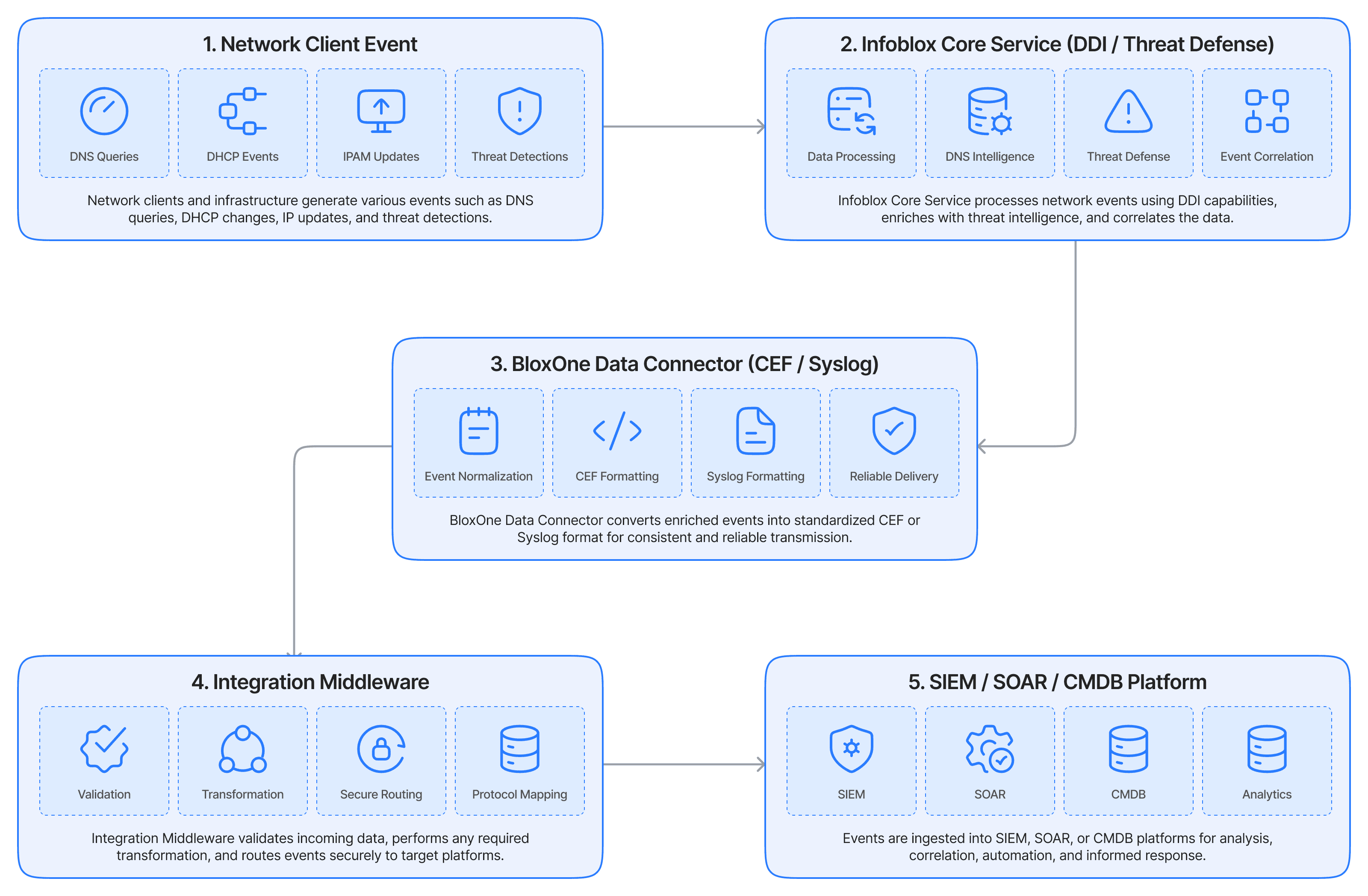
Data flows bidirectionally between the Infoblox core platform and external applications. Upstream network transactions (like DNS queries or DHCP leases) funnel into an internal parsing service. The integration layer uses these logs to extract contextual data (such as client IP, queried domain, and severity) and formats the output into structured messages. Simultaneously, external configuration and orchestration platforms push provisioning actions back to the Infoblox platform using secure APIs to modify network settings automatically.
Streamlined Logic
1. Event Capture: Infoblox processes a local network transaction (e.g., an endpoint requests a malicious external domain or requests a new DHCP lease).
2. Log Generation: The system formats the event data as a syslog payload or Common Event Format (CEF) message inside the Infoblox environment.
3. Data Connector Export: The BloxOne Data Connector extracts the formatted logs and pushes them securely to an external ingestion endpoint over UDP or encrypted TLS.
4. Context Extraction: The receiving integration parses the fields, mapping items like client IP addresses and domain reputations into a normalized schema.
5. Downstream Action: The integration can enrich asset inventories, create or update security incidents, trigger SOAR playbooks, or initiate network and security actions based on the parsed data.
Infoblox Integration Benefits
Threat and Indicators of Compromise (IOC) Ingest
We pull structural threat feeds, domain reputations, and real-time DNS-centric indicators from Infoblox TIDE (Threat Intelligence Data Exchange) directly into threat intelligence platforms (TIPs) and firewalls.
Network & Security Events Ingest
We stream raw DNS queries, responses, security hits, and DHCP lease logs via the Infoblox BloxOne Data Connector into central SIEM and analytics repositories.
Asset Enrichment & CMDB Sync
We automatically push discovered endpoint context, MAC-to-IP bindings, and user attribution data into asset repositories like ServiceNow to clear up visibility gaps.
SOAR Actions & Orchestrated Playbooks
We connect Infoblox security intelligence with SOAR platforms to automate response workflows, enabling teams to investigate or contain compromised endpoints based on malicious DNS activity and other security signals.
Infrastructure as Code (IaC) Network Automation
We integrate dynamic DDI provisioning directly inside developer tools, automating IP allocation and DNS record updates during infrastructure deployments.
Integration Use Cases
Automated Threat Containment
We coordinate rapid incident isolation by binding Infoblox threat alerts to endpoint detection response (EDR) actions. When Infoblox flags a local endpoint making malicious C2 queries, the integration immediately signals the EDR framework to quarantine or investigate that host.
Dynamic Infrastructure Provisioning
We eliminate manual tickets by pairing automated pipelines with real-time IPAM data. When cloud teams spin up new clusters via infrastructure tools, the integration handles IP allocation and creates/ updates the required DNS records.
Authoritative Context Enrichment
We augment security analytics with rich network identity markers directly inside downstream SIEM consoles. Instead of analyzing a bare IP address, security analysts instantly view user attribution, device categories, and physical network locations.
Similar Connectors